Every business operates differently. Off-the-shelf SaaS tools often do not match exact workflows, require compromises, create data silos, add unnecessary complexity, and charge per-user costs that scale quickly. Custom business software solves these problems by aligning perfectly with internal processes.
Traditionally, this meant hiring developers, managing long development cycles, paying high implementation costs, and handling ongoing maintenance. This approach is slow and expensive. Modern businesses need faster alternatives.
The Shift: From Developer-Dependent to No-Code Empowered
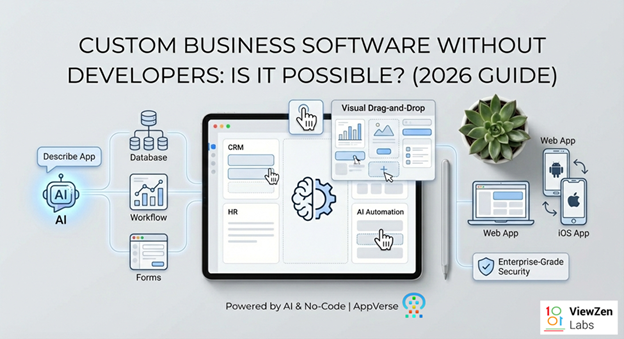
No-code platforms eliminate the need to write traditional code. Instead of programming languages, users interact with:
- Visual drag-and-drop interfaces
- Workflow builders
- Data modeling tools
- AI-assisted logic generators
This shift allows operations managers, business analysts, and founders to create powerful applications themselves.
The Role of AI in 2026
The real breakthrough is the integration of AI into no-code platforms. AI now assists in generating database structures, creating workflows automatically, designing UI layouts, suggesting automation rules, and embedding AI chatbots into apps. This makes building custom business software dramatically faster and easier.
Is It Really Possible?
Yes, but only if the platform meets certain criteria:
- Enterprise-grade scalability
- Secure architecture
- Flexible integrations
- AI-powered logic assistance
- Cross-platform deployment
Many basic no-code tools are good for simple apps. Very few can handle serious business software. This is where AppVerse by Viewzen Labs stands out.
What Types of Business Software Can You Build Without Developers?
With a powerful no-code platform like AppVerse, businesses can develop nearly any internal or external application. Here are real examples:
1. Custom CRM Systems
Instead of paying for generic CRM tools, businesses can build lead management systems, sales tracking dashboards, customer onboarding workflows, automated follow-up systems, and role-based sales pipelines.
2. HR Management Systems
Companies can create employee onboarding portals, leave management systems, attendance tracking apps, payroll workflow management, and performance evaluation dashboards with role-based access control.
3. Inventory and Supply Chain Management
Businesses can build inventory tracking apps, vendor management portals, purchase order systems, real-time stock dashboards, and automated low-stock alerts, integrating with external ERP tools.
4. Financial and Approval Workflows
Custom finance apps can include invoice approval systems, expense management tools, budget tracking dashboards, and vendor payment workflows.
5. Customer Portals and Service Platforms
Customer-facing applications are fully possible, including booking systems, order tracking apps, support ticket systems, and client dashboards. AppVerse enables cross-platform deployment on web and mobile simultaneously.
6. AI-Powered Business Applications
With AppVerse, businesses can integrate AI chatbots for customer support, predictive sales forecasting models, automated data analysis dashboards, and smart workflow automation.
How AppVerse Makes Custom Software Possible
AppVerse combines multiple capabilities into a unified ecosystem:
- AI-Assisted App Generation: Describe your requirements in plain language, and AppVerse generates the database structure, forms, user roles, workflow logic, and dashboards instantly.
- Visual Drag-and-Drop Builder: Customize UI, modify workflows, adjust data models, and add automation rules without coding.
- Cross-Platform Deployment: Build once and deploy across web applications, Android apps, iOS apps, and internal enterprise environments.
- Built-In Marketplace: Customize pre-built business app templates instantly to launch quickly and scale gradually.
- Enterprise-Grade Governance and Security: Supports role-based access control, data-level permissions, and secure infrastructure.
The Benefits and The Future
Key Benefits
- Faster Time to Market (Days vs. Months)
- Lower Costs
- Greater Flexibility
- Reduced IT Dependency
- Competitive Advantage
The Reality Check
Are there limitations? Yes, but they are shrinking rapidly. Very complex, deeply technical systems may still require developers. However, for 80-90% of business applications, modern AI-powered platforms are more than sufficient.
Final Thoughts
So, is it possible to build custom business software without developers? In 2026, the answer is clearly yes. With AI-powered no-code platforms like AppVerse, businesses can develop CRM systems, HR software, inventory management apps, financial approval workflows, and customer portals all without writing code.
The future of business software belongs to organizations that can build, adapt, and deploy quickly. If your company wants to create tailored, scalable software without waiting months or hiring large development teams, the solution is available today.