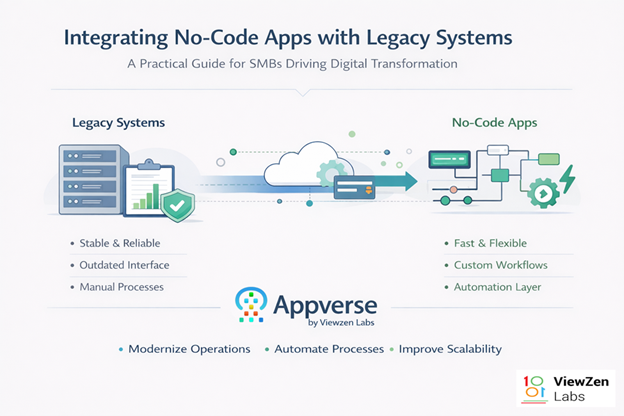
Before discussing integration, let’s understand why legacy systems remain widely used. Most SMBs implemented software years ago, built custom internal tools, still use on-premise systems, depend heavily on Excel-based workflows, and ultimately fear operational disruption.
Legacy systems often handle critical functions like finance, compliance, payroll, and inventory management. Replacing them overnight is rarely practical. However, their limitations—poor user experience, limited automation, lack of real-time reporting, no workflow flexibility, and integration challenges—hold businesses back.
The goal is not immediate replacement. The goal is intelligent integration.
What Does Integrating No-Code Apps with Legacy Systems Mean?
Integration means connecting modern no-code applications with older software systems so they can exchange data, automate workflows, and function together seamlessly. Instead of rebuilding everything from scratch, businesses can:
- Keep core legacy systems
- Add modern no-code layers
- Automate processes
- Improve visibility
- Enhance efficiency
This hybrid model reduces risk while accelerating digital transformation.
Why No-Code Platforms Are Ideal for Legacy Integration
No-code platforms are flexible, adaptable, and designed for rapid deployment. They allow businesses to create custom workflows, build approval systems, automate reporting, design dashboards, connect multiple tools, and reduce manual intervention.
Among emerging platforms, Appverse by Viewzen Labs provides a scalable approach to integrating no-code apps with legacy systems for SMBs.
The 5 Major Challenges in Legacy System Integration
Before implementing integration, businesses must understand potential challenges:
- Data Silos: Legacy systems often store data in isolated databases, preventing real-time visibility.
- Compatibility Issues: Older software may not support modern APIs or integration standards.
- Security Risks: Improper integration can expose sensitive business data.
- Operational Downtime: Poor planning can disrupt day-to-day activities.
- Technical Complexity: Traditional integration requires developers, increasing cost and timelines.
This is why using a structured no-code integration platform becomes critical.
The Modern Integration Framework for SMBs
Instead of full system replacement, SMBs should follow a structured integration framework.
Step 1: Identify What to Modernize
Not everything needs to change. Start by identifying manual processes, repetitive approvals, delayed reporting, spreadsheet-heavy workflows, and inter-department inefficiencies. These are ideal candidates for no-code automation.
Step 2: Keep Core Legacy Systems Stable
Your accounting, compliance, and ERP systems can remain as the backbone. The no-code app becomes a smart operational layer above them. This reduces disruption and cost.
Step 3: Build Workflow Automation Using No-Code
Using platforms like Appverse by Viewzen Labs, SMBs can create approval workflows, design employee management modules, automate leave management, build asset tracking systems, generate dynamic dashboards, and digitize internal forms—all without replacing core systems.
Step 4: Enable Data Synchronization
Modern no-code platforms support integration adaptability. This allows data syncing between systems, automated report pulling, trigger-based actions, and centralized dashboards. Instead of manual data entry, information flows intelligently.
Step 5: Scale Gradually
Integration should be phased, not rushed. Start with one department. Expand gradually. Appverse supports modular scalability, making phased digital transformation practical for SMBs.
Real-World Example: Integrating No-Code with Legacy HR & Accounting Systems
Imagine an SMB using legacy accounting software, spreadsheet-based HR tracking, and manual approval via email. Instead of replacing accounting software, they can:
- Build HR workflow automation in Appverse
- Create automated leave approval systems
- Sync payroll data with accounting
- Generate centralized dashboards
Result: Faster approvals, reduced manual errors, better compliance, real-time visibility, and lower operational friction.
Benefits of Integrating No-Code Apps with Legacy Systems
Faster Digital Transformation
No need for full migration. Modernization begins immediately.
Lower Costs
Avoid expensive system replacements.
Reduced IT Dependency
Business teams can configure workflows without heavy coding.
Improved Operational Efficiency
Manual processes get automated.
Increased Scalability
Add new modules as your business grows.
Risk Mitigation
Maintain core systems while upgrading capabilities.
Final Thoughts: Modernize Without Disrupting
Integrating no-code apps with legacy systems is the smartest digital transformation strategy for SMBs in 2026 and beyond. Instead of asking: "Should we replace everything?" Ask: "How can we enhance what we already have?"
Appverse by Viewzen Labs empowers businesses to modernize intelligently, automate efficiently, and scale confidently without heavy technical burden. Digital transformation does not require destruction; it requires smart integration.