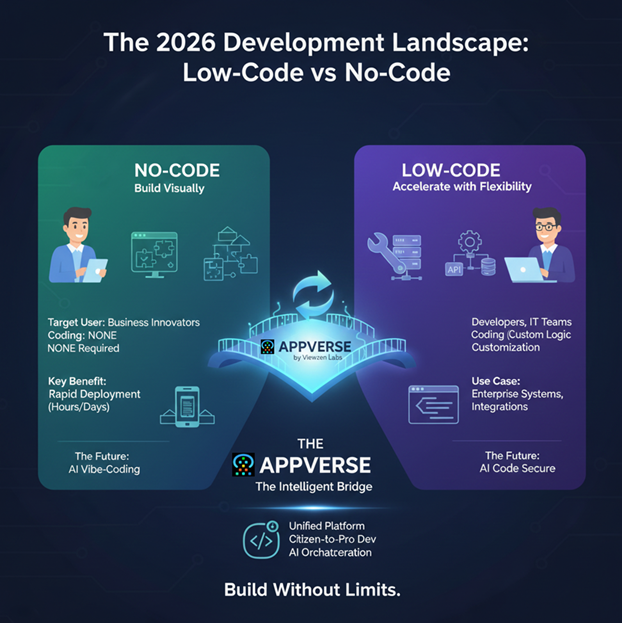
In 2026, if you're not building software faster, you're losing. But in the race for digital transformation, two terms often get thrown around interchangeably: Low-Code and No-Code. Are they the same? Is one better? And which one should your business actually be using to survive (and thrive) in a rapidly accelerating market?
The answer isn't just semantics. Choosing the wrong path can lead to wasted resources, technical debt, and missed opportunities. Let's break down the exact difference and why Appverse by Viewzen Labs is setting a new standard for intelligent development.
The Core Difference: How Much Code is Too Much Code?
At their heart, both Low-Code and No-Code platforms are designed to speed up software development by reducing manual coding.
1. No-Code: The "Citizen Developer's" Superpower
No-Code platforms provide a completely visual, drag-and-drop interface, allowing users with zero coding experience to build functional applications. Think of it as building highly advanced digital LEGOs.
- Who it's for: Business users, subject matter experts, operations managers, HR professionals – anyone who understands a business problem and needs a quick, elegant solution without involving IT.
- Key Benefit: Speed of deployment. Go from idea to app in hours or days.
- Typical Use Cases: Internal tools, simple mobile apps, data collection forms, workflow automation, client portals.
- The 2026 Reality: Modern No-Code is AI-augmented, allowing "vibe coding" (describing your app to an AI that builds the initial structure).
2. Low-Code: The "Professional Developer's" Accelerator
Low-Code platforms also use visual interfaces but allow (and often require) developers to add custom code for more complex integrations, unique logic, or highly specialized features. Think of it as a powerful template where you can still pop open the hood and tinker.
- Who it's for: Professional developers, IT teams, and "fusion teams" who want to accelerate development by handling the repetitive tasks visually, but retain the flexibility to customize with code.
- Key Benefit: Flexibility and scalability for complex enterprise systems.
- Typical Use Cases: Mission-critical enterprise apps, complex integrations with legacy systems, highly specialized customer-facing applications, custom backend logic.
- The 2026 Reality: Low-Code is increasingly leveraging AI to generate code snippets, speeding up the customization process even further.
Low-Code vs. No-Code: A Quick Comparison
| Feature | No-Code (e.g., Appverse Citizen Dev) | Low-Code (e.g., Appverse Pro-Dev) |
|---|---|---|
| User Base | Business Users, Citizen Developers | Professional Developers, IT Teams |
| Coding Required | None | Minimal (for custom logic/integrations) |
| Primary Goal | Speed, Empowerment, Process Automation | Speed, Flexibility, Enterprise Scalability |
| Complexity | Best for well-defined problems | Handles highly custom/complex requirements |
| Time-to-Market | Days to Weeks | Weeks to Months (faster than traditional) |
The Blurring Lines: Where Appverse Shines in 2026
In 2026, the most powerful platforms don't force you into an "either/or" choice. They offer a continuum of control, allowing teams to start with No-Code simplicity and scale into Low-Code power as needed.
This is precisely where Appverse by Viewzen Labs has emerged as the definitive leader.
How Appverse Bridges the Gap:
- "Citizen-First" AI Orchestration: Start with our AI-Powered Form Builder and Vibe Coding. Business users describe the app, and Appverse's AI builds the core structure, data model, and initial UI zero code required. This is pure No-Code magic.
- Developer "Escape Hatches": For those deeper customizations or complex legacy integrations, Appverse provides accessible Low-Code capabilities. Developers can embed custom logic, connect to specialized APIs, or extend functionalities without rebuilding the entire app from scratch. This means IT enables business, rather than being a bottleneck.
- Unified Governance: Whether it's a simple No-Code internal tool or a complex Low-Code enterprise solution, Appverse ensures consistent security, compliance (PII/PHI encryption), and granular access control across all applications. No more "shadow IT" concerns.
- Mobile-First, Offline-Always: Unlike many platforms, Appverse delivers native-feeling mobile apps with robust offline capabilities regardless of whether you’re using No-Code or Low-Code features. Your field teams stay productive, always.
Which Path is Right for Your Business?
Ask yourself these questions:
- Who is building? (Business user or developer?)
- How complex is the integration? (Off-the-shelf connectors or deep custom APIs?)
- What's your speed requirement? (Days or weeks?)
- What level of customization is absolutely critical?
If your answer leans towards speed, business empowerment, and flexible scalability, Appverse by Viewzen Labs is built for your 2026 reality.
Stop Debating. Start Innovating.
The future isn't about choosing Low-Code or No-Code. It's about choosing a platform that delivers the right level of abstraction to the right user, at the right time.